
Blog
Do You Need Both Cord Blood & Cord Tissue Banking? A Practical Guide
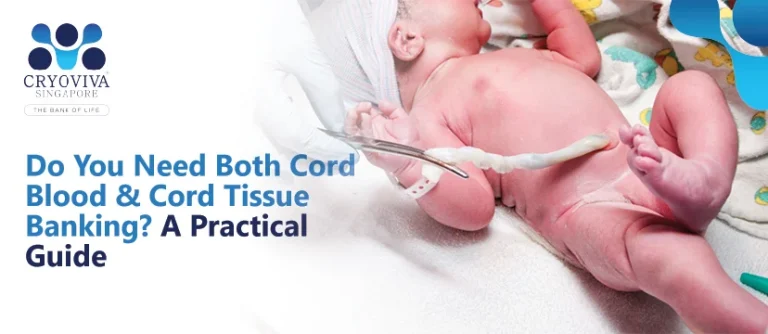
Let’s imagine a scenario. If ever you’re told to choose between food and water, what would you do? Naturally, you’d never pick just one, as both are crucial to survive.
The same concept can be applied to choosing between cord blood and cord tissue banking. It’s not compulsory, but many parents in Singapore choose both because they both offer unique benefits for future health needs.
Let’s explore in detail why you can opt to choose both.
-
Cord Blood Banking
It is the process of collecting, processing, and cryo-storing stem cells (at ultra-low temperatures (below -150°C)) from the blood left in a baby’s umbilical cord just after childbirth.
It’s a way for stem cell preservation from the source, the newborn umbilical cord blood.
What is Cord Blood
It is the blood that remains in the placenta and umbilical cord after the delivery.
Type of Stem Cells Present in the Umbilical Cord Blood
It is rich in Hematopoietic Stem Cells.
Why Parents in Singapore Choose Cord Blood Banking
Because they know Hematopoietic Stem Cells offer the following benefits:
- Support treatment of over 80 diseases such as cancers, blood disorders, and immune issues.
- Help rebuild blood cells often after chemotherapy.
- Cord blood HSCs have a lower rejection risk. This lowers complications like graft-versus-host disease.
- When stored in Private Banks like Cryoviva Singapore (an AABB-accredited private cord blood bank), they are ready to use anytime.
- They remain healthy for decades (over 20 years proven) if stored properly in a Ministry of Health (MOH) licensed facility.
- They can be used by siblings, parents, and close family members if the matching criteria are fulfilled.
Matching Required
Yes, matching is required between the donor and recipient for a successful transplant.
- For Siblings: There is a 25% chance of being a perfect HLA match and a 50% chance of a close partial match.
- For Parents: A good chance of being a partial match.
- For Grandparents and Other Close Family: under 25% partial match.
HLA matching compares proteins known as human leukocyte antigens on cells to ensure transplant compatibility. The closer the match lower the complications, such as graft-versus-host disease, GVHD (where donor cells attack the recipient’s healthy tissues).
There is no known risk of GVHD with your baby’s own stem cells. If opting for family cord blood banking, there are chances of a closer match.
FDA Approval
Many treatments are FDA-approved. Some of the benefits are still in their initial phases of clinical trial.
Number of Treatments per Stored Sample
Generally, one treatment per stored sample.
Storage Time
Can be stored for up to 23.5 years without losing their ability to address medical conditions.
-
Cord Tissue Banking
It is the process of collecting, processing, and cryo-storing stem cells (at ultra-low temperatures (below -150°C)) from the umbilical cord’s tissue (Wharton’s jelly) just after childbirth.
It’s a way for stem cell preservation from the source, the newborn umbilical cord tissue.
What is Cord Tissue (Also Known as Wharton’s jelly)
It is a soft, jelly-like substance inside the umbilical cord, surrounding and protecting the blood vessels. Think of it like a cushion to keep the umbilical cord’s blood vessels safe from the pressure and movement during pregnancy and delivery.
Type of Cord Tissue Stem Cells
It is rich in Mesenchymal Stem Cells.
Why Parents in Singapore Choose Cord Tissue Banking
Because they know Mesenchymal Stem Cells offer the following benefits:
- Dial down overactive immune responses (beneficial effect in arthritis or autoimmune diseases such as multiple sclerosis).
- Support damaged tissue repair.
- Lower transplant rejection.
- They support speeding up skin and tissue repair, like in diabetic ulcers.
- There is no cure for cerebral palsy yet; however, comprehensive treatment along with cord tissue stem cell therapy can help manage the symptoms, making the child more independent.
- 2025 research found that stem cell therapy can protect insulin-producing cells and regulate immunity in children. This can be beneficial for addressing type 1 diabetes.
Matching Required
No matching is required for the same person or a close family member.
FDA Approval
Most therapies are still in research and the early clinical trials phase. The scientific community is exploring it more for the potential benefits it offers.
Number of Treatments per Stored Sample
Cells can multiply; hence, multiple treatments are possible.
Storage Time
Can be stored for up to 23.5 years.
-
Why Choose Combined Banking (Blood + Tissue)
- Help store both types of stem cell HSCs and MSCs. This helps offer more medical coverage.
- Doctors in Singapore can use them for the Co-transplantation of HSCs and MSCs, which can improve the likelihood of successful treatment.
- Safe, painless, and easy to collect.
- Both stem cells are young and have not been exposed to environmental stress factors or diseases.
-
How to Choose?
- Know your family history.
- Know your budget; choosing both can be a bit costly.
- Contact the MoH-licensed, AABB-accredited, and ISO 9001:2015 QMS Certified family cord blood bank in Singapore for the right guidance.
- Do your own research about the ongoing research and benefits of cord blood and cord tissue therapy.
A Quick Overview?| Cord Tissue vs Cord Blood |Which One to Choose
Read this comparison and then make an informed choice.
|
Key Aspects |
Cord Blood Banking |
Cord Tissue Banking |
|
Stem cell source |
Umbilical cord blood |
Cord Tissue (Wharton’s jelly) |
|
Type of stem cells |
Hematopoietic Stem Cells |
Mesenchymal Stem Cells |
|
Matching required |
Yes |
No |
|
FDA Approval |
Many treatments are FDA-approved |
Many treatments are still in their initial research phase |
|
Number of treatments |
Usually, one treatment per stored sample |
Cells can multiply. Therefore, multiple treatments are possible. |
Choose both if you want wider coverage from possible future conditions for your baby.
Want help in your decision-making? Then contact us at:
Phone number: (65) 8339 8482
Address: Corporate Office 37 Jalan Pemimpin, #01-06 Mapex, Singapore 577177
Write Us: enquiry@cryoviva.com.sg
Check Cord Blood Retrieval Record for Transplant
Disclaimer: This blog is for informational use only. For any condition that requires stem cell therapy, you must contact your healthcare professional only.
Note: This content is medically reviewed by the Cord Blood Collection Team of Cryoviva Singapore, a leading private cord blood bank in Singapore that has successfully stored over 10,000 umbilical cord blood and cord tissue units. All content is medically reviewed to ensure reliability and clinical accuracy.
FAQ's
What is the stem cell preservation cost in Singapore?
The cost may vary based on the type of facility and other individual factors. At Cryoviva Singapore, you can get the best coverage at an affordable price. Our cost ranges between 5,000 and 8,000 SGD.
Which facility is known for newborn stem cell banking in Singapore?
Cryoviva Singapore (an AABB-accredited private cord blood bank) is known for the best cord blood and tissue facility. Because of our advanced technology, such as the AXP® II System, Long-term cryopreservation system, and Explant Technology (a non-enzymatic method of culturing the tissues)
What is a cord blood collection kit?
It is a specially designed kit to ensure the safe, sterile, and efficient collection of your baby’s umbilical cord blood and tissue right after childbirth.

