
Blog
Top 5 Myths About Cord Blood Banking Debunked
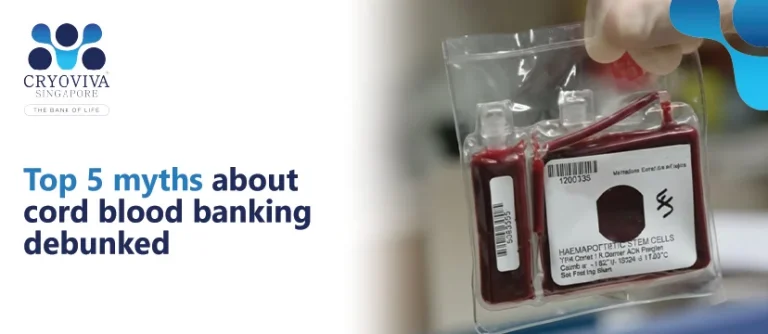
They say one myth can create a more damaging ripple effect than a hundred truths, and it’s so truthful when it comes to cord blood banking (a stem cell preservation method). Negative information tends to spread faster, and before you know it, one misleading statement can force parents to step back from something that can honestly benefit their child’s future health.
Many parents in Singapore are already contemplating how to safeguard their child in a world of changing environmental and health challenges. Hence, getting the facts right and debunking top myths about cord blood banking truly matters.
5 Common Private Cord Blood Banking Myths Debunked
Make sure you do not believe in these myths without proper research, because believing them might take away potential benefits of safeguarding your family’s health in the future.
Myth 1: All Cord Blood Banks are the Same.
The Truth:
Not all cord blood banks are the same. Each is different in its quality, safety standards, technology, and service availability. One of the known ones is Cryoviva Singapore, which stands out as one of the most reliable private cord blood banks, providing over 18 years of assurance in the country.
Parents in Singapore prefer us for our following qualities:
- Internationally approved quality and safety standards for stem cell collection, processing, and storage.
- We have an 18+ year proven track record in cord blood stem cell preservation.
- Known for transparent pricing without any hidden charges.
- Possesses AABB Accreditation for both Cord Blood and Cord Tissue preservation.
- Quipped with the Explant Technique Non-enzymatic method of culturing the tissue in the most natural condition. This means a better yield of highly viable cells for safe and efficient medicinal use.
- FDA-cleared, functionally closed automated system. This helps lower processing time and is cost-effective, as it runs 6 devices in one centrifuge.
- The baby’s cord blood is processed and preserved by our experienced technical team in the Ministry of Health (MOH) licensed facility.
Choosing Cryoviva means every sample is collected, processed, and stored with the highest level of precision. You will have peace of mind, knowing your child’s cord blood is preserved in a (MOH) licensed facility that is aligned with the global standards and prioritizes your family’s long-term health and safety.
Myth 2: Private Cord Blood Banking is too Expensive.
The Truth:
Many parents are under the wrong impression that it will be too costly. At Cryoviva Singapore, the collection and preservation service is priced in a range that makes it accessible for families. This makes a baby’s cord blood preservation the most affordable health investment for their future health. Our pricing ranges between 5,000 and 8,000 SGD, giving you real value for money for your family’s future without breaking the bank.
Also Read: Cord Blood Banking Costs in Singapore: What Parents Should Expect
Myth 3: Cord Blood is Only Viable for a Few Years.
The Truth:
This myth no longer holds water with modern cryopreservation techniques (storage in liquid nitrogen at -196 degrees Celsius); research has suggested that cord blood stem cells can be stored for up to 23.5 years with no significant impact on viability. Some laboratories have even reported viability beyond 27 years. This suggests that long-term preservation is possible and highly effective when done correctly.
Myth 4: You cannot Use Your Child’s Own Cord blood for your own Treatment.
The Truth:
Yes and No. The myth is partially true. Umbilical cord blood collected from a baby cannot be used to address a genetic disease (like sickle cell disease or thalassemia) or malignancy in that same individual (autologous transplant). This is because stored cord blood contains the same genetic variant or premalignant cells. After all, the genetic mutations are present in the cord blood as well.
However, it can be used to address non-genetic or environmentally triggered diseases, such as certain cancers like leukemia, neuroblastoma, or autoimmune diseases. There is ongoing research exploring its use in regenerative medicine for other health conditions.
Read the success story of 6-year-old Harshita, who had a genetic condition, with the help of umbilical cord blood.
Myth 5: Cord Blood is not a Preferred Source for Stem Cell Transplants.
The Truth:
Cord blood is becoming a preferred and valuable source for stem cell transplants. Compared to other sources, cord blood stem cells have unique benefits: they need less strict tissue matching, hence the lower risk of graft-versus-host disease (GVHD), a serious transplant complication. Cord blood is safely collected non-invasively with the help of a professional technician and is readily available from banks, unlike other methods, which require a more invasive donation procedure.
Book an appointment Now
Conclusion
You cannot always prevent myths from reaching your feed or ears; however, you can definitely check if the information is true or not. Stem cells (hematopoietic stem cells) from cord blood are younger and more effective at healing and tissue regeneration.
These stem cells have the potential to treat over 80 diseases, making them highly valuable. Collecting and processing the stem cells from cord blood right after delivery is completely safe for both mother and baby.
Are you ready to store cord blood, a valuable resource worth considering for future health needs?
Then contact Cryoviva Singapore, which is AABB accredited and is ISO 9001:2015 QMS Certified and backed by reputed organizations like Indorama Ventures and RJ Corp.
Call Us (+65 83398482)
Address: Corporate Office 37 Jalan Pemimpin, #01-06 Mapex, Singapore 577177
FAQ's
Is cord blood banking worth it in Singapore?
Yes, it can be worth it, as stem cells from cord blood can treat many diseases and may help parents or immediate family members. Many private banks are offering this service at a very affordable price.
What is cord blood banking used for?
Cord blood stem cells have the potential to address 80+ health conditions. It can help in blood cancers, immune disorders, and other diseases and support tissue repair, often when a bone marrow match isn’t available.
What happens 100 days after a stem cell transplant?
Around 100 days post-transplant, the doctor will track if new blood cells are working efficiently. Individuals are closely watched for infections and graft-versus-host disease. Reaching the 100-day mark after a stem cell or bone marrow transplant is a major milestone that usually means better long-term recovery. However, ongoing care is required for the best outcome.

